I attended the January 25, 2024, Camden County Commission meeting at 10:00 a.m.
All commissioners were present.
The first agenda item was Charlene Moore – Proposed Ruling on Homeschooling – Proposed County Resolution.
Charlene Moore spoke to the Commission as a representative of three different Camden County homeschool co-ops. I’ll provide a quick impression below, but I obviously won’t do it justice because I don’t have the space.
To make a very general summary of her thorough presentation, Missouri has passed legislation that offers money to homeschooling parents, but if families agree to enroll in these programs, they are required to meet certain certification standards and comply with the requirements of those programs. The vast majority of Missouri homeschool parents do not want the money if it means they will have to participate in these state programs. Charlene also spoke about some of the organizations who are behind these efforts.
There were a half dozen families present at the meeting with their children and they definitely seemed like they were there to support homeschooling. The general mood of the families and the presentation was that Missouri homeschool families don’t want the state funding. They’d rather just be left alone. The Commission was very supportive of their efforts and the challenges they are facing.
https://fhe-mo.org/newsalerts/1066-Action-Needed–SB-255
The thing that really jumped out at me from this presentation is a trend that I’m starting to see more often even at the local levels: Government seeking new ways to intrude into the lives of its citizens.
A parent chooses to teach their child at home even though they pay taxes into the public school system. The government decides to give this parent money, a tax rebate, a savings account, or a tax credit to make things more fair because the parent is not using the public school system. A year later, the government insists that the parent needs to participate in surveys, certifications, assessments, and other control measures.
And how does the government justify this extra scrutiny? Because they need to make sure that the money they gave to the parent is being used properly. You bit at the worm and you got the hook.
By leaving the door open a crack, you’ve let the wolf in. Nothing is free. Everything comes with a price. The most frustrating fact is that, in most cases, the bait they’re offering is your own tax money.
The second agenda item was 24012-A Sheriff’s Uniform Bid Opening.
They received two bids for Sheriff’s uniforms. The representative from the Sheriff’s Office asked for the Commission to accept both bids because the pricing between the two bids varied. Selecting from both bids would allow the Sheriff’s Office to pick the best deals from either vendor.
The Commission voted unanimously to accept both bids.
The third agenda item was 240125-B Sheriff’s Body Armor Bid Opening.
There were no bids so they are going to have to seek out more vendors.
This was pretty surprising to me because I assumed there would be a state contract vendor at the state level that Missouri law enforcement agencies could use. A quick search revealed plenty of vendors for this item so I’m sure they’ll have this worked out in no time.
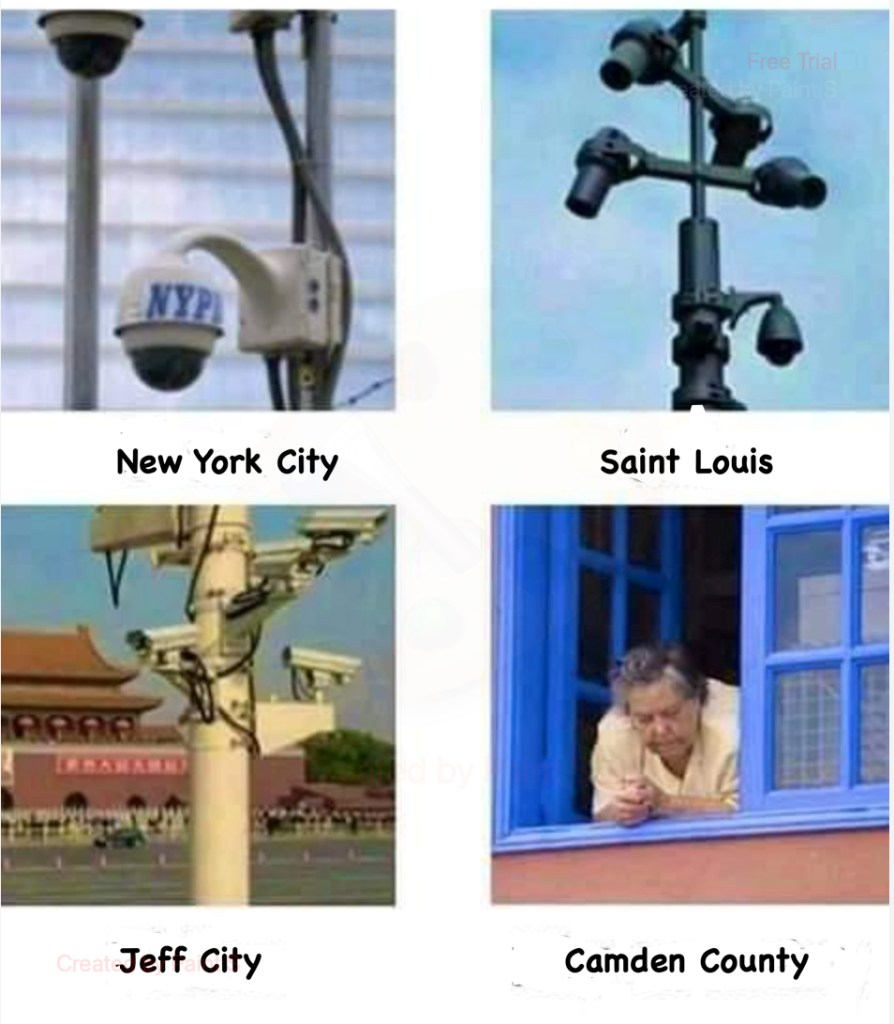
The final agenda item was Automatic License Plate Readers Ordinance Amendment(s).
Presiding Commissioner Skelton read an excerpt from an MOU (Memorandum of Understanding) that was signed by Sheriff Helms and Flock (the vendor who owns and operates the license plate reader cameras). According to Skelton, the MOU granted Flock and its licensors the right to retain all interest in recordings or data provided by the Flock service. Flock retained the right to use that data for any purpose at Flock’s “sole discretion.”
Commissioner Skelton explained that public-private partnerships like the MOU between Sheriff Tony Helms and Flock are a way to get around the constitution. In Skelton’s opinion, when entities of the government “get in bed” with public-private partnerships, “it doesn’t look nefarious, but it is nefarious.” The license plate readers (LPR’s) of Flock are searching every vehicle that drives by them every day. Skelton said, “You can call it whatever you want. It is a collection of the information and a search.”
Skelton felt that if any county or Sheriff’s department were to purchase an LPR for themselves and deploy it, it would be found to be unconstitutional because it is a continual search of everyone who drives by. Partnering with Flock allowed them to get around the Constitution.
Commissioner Gohagan asked when the MOU with Flock was signed? Skelton informed him that the MOU was signed May 15, 2022. It was signed by Sheriff Helms and the Chief Revenue Officer from Flock. A citizen in the audience asked the Commission why the Sheriff signed the MOU when only the Commission retained the authority to sign all contracts on behalf of Camden County? Skelton agreed with the citizen that Sheriff Helms’ disregard for the Commission’s authority would render the MOU null and void.
The Commission came to the meeting with several different versions of an ordinance that would ban the use of license plate readers (LPR) in Camden County.
- One version prohibited static LPR’s that weren’t mounted on vehicles throughout Camden County.
- Another version prohibited all LPR’s in unincorporated areas of Camden County.
- I think there was a third version, but the explanation of that one was a bit confusing. I think this one banned all flavors of LPR’s everywhere but state highways? (I’m doing the best I can, folks.)
The original ordinance passed by the Commission prohibited static LPR’s except in incorporated areas or highway right-of-ways. Commissioner Skelton said they had received some legal advice that they could not regulate municipalities and highways. He mentioned that the State of Missouri is currently trying to pass a law that would allow them to put LPR’s on state highways so that might indicate that even the state government doesn’t feel they have that authority yet.
Skelton did not believe that it was appropriate for the Sheriff to sign the MOU with Flock. He said that the Commission will be contacting Flock to have the camera on Highway 54 removed.
(I had assumed that the Highway 54 LPR was put up by Missouri DPS so I was a little surprised to hear that the Sheriff was the signee for the MOU.)
Commissioner Gohagan felt that Secretary of Transportation (Prior Mayor of South Bend) Pete Buttigieg was really pushing the deployment of LPR’s because they had received so much federal money from infrastructure and transportation funding. Gohagan commented that Commissioner Williams had previously voiced concerns about having the LPR’s in cars, but Gohagan did not have a problem with LPR’s that are assigned to a vehicle with an officer in it.
Williams responded that he did not understand how the LPR’s worked. According to Williams, if the mobile LPR’s operated the same way as the static LPR’s with constant monitoring, he put them in the same category. Williams had an issue with the fact that the LPR’s automatically check every plate that comes in front of them.
Commissioner Skelton tried to explain how the LPR’s worked to Commissioner Williams.
Williams stated that there “were several different concerning aspects to this.”
County Attorney Green had prepared three different versions of the LPR ordinance, but it still seemed the Commission was prepared to amend Jeffrey’s hard work to strike lines and create a different fourth version.
From far away in Old Kinderhook, one could almost hear the relieved laughter of Charles McElyea (former Legal Counsel to the Commission) floating past Ha Ha Tonka.
A Sheriff’s representative asked if this would affect private businesses. Skelton responded that it would not affect them, but a County Commission could prohibit the information from a privately owned LPR from getting to law enforcement. He said the Commission was not going to agree to any MOU with Flock.
A Sheriff’s Captain asked to clarify the difference between an MOU and a contract? He understood that a contract was legally binding while an MOU was not. County Attorney Green agreed with that statement. A citizen then verified that Camden County’s statutory legal consulting service had already opined that the MOU was invalid? Commissioner Skelton confirmed that their legal advisor stated the MOU with Flock is null and void.
So it appears the Sheriff signed a contract sharing the license plate data that the LPR on Highway 54 was gathering with Flock (to do with whatever they will) with no authority to do so.
(A quick explanation might be needed before I describe the next part of the meeting so everyone understands what exactly is happening. The Commission consists of three commissioners. Commissioners Gohagan and Williams are the 1st and 2nd District Commissioners. Presiding Commissioner Skelton has no district, but he runs the agenda.
The District Commissioners will usually make motions to put items before a vote. The motion will then be seconded by another commissioner, discussed, and put to a vote. Most motions pass 2-0. If there is a disagreement, an abstention, or a tie vote, the Presiding Commissioner can vote to break the deadlock. The Presiding Commissioner, in rare circumstances, can make his own motions and second other motions.)
Presiding Commissioner Skelton said that he would entertain a motion to prohibit LPR’s throughout the county without exceptions. He asked Commissioner Williams his opinion and told Williams that he had been given a long time to research the matter.
Commissioner Williams said that he “had gone back and forth on this issue so many times.” He had talked to County Attorney Green and two other attorneys and they didn’t believe the Commission had the authority to ban LPR’s on city streets and state highways. He was concerned that banning the cameras might have unforeseen and unintended consequences.
Skelton said he did not need any more time to consider these ordinances. He felt that the LPR’s were a violation of the 4th Amendment of the US Constitution and the Missouri Constitution against unreasonable search and seizure.
Williams said he agreed and that “in a lot of cases, it constitutes unreasonable search and seizure. Like I said, to me I compare it to what the Gestapo did in Europe in World War Two where they would just…”
Skelton interrupted, “Well, pull the trigger, sir. Pull the trigger.”
“I don’t feel like I know enough to…to..to..possible consequences to…ban them wholesale,” equivocated Williams.
Gohagan responded to Williams, “Well, Donnie, you wanted them and you wanted the cars added to the exceptions. That was your request.”
Skelton clarified that his concern was that the MOU stated that the LPR’s would collect data and that the company could do whatever they wanted with that data.
Williams stated that before the Commission did a wholesale banning of the LPR’s, they needed to take a closer look at all of the concerns and potential consequences. Commissioner Williams said that one of his concerns was that “If we ban them, it will absolutely almost certainly have real world impacts at some point. There’s always the tension between safety and security on one hand and giving up constitutional rights on the other hand, you know. Every time you gain more security, you’re usually giving up some of your rights at some point.”
Gohagan asked, “What crime is it going to prevent though?”
Williams persisted, “Let me finish. What I’m saying here is that this will have real world impacts at some point, there’s going to be a criminal, whether it’s a minor criminal or if it’s a murderer, that will drive down the highways and streets in Camden County and his plate won’t get picked up because we don’t have the cameras and if he was in a different county, it would have. But, like I said, is it worth it to know that you’re going to catch, you know, more criminals to give up your Constitutional rights? You know what I mean? That’s always the conflict.”
Presiding Commissioner Skelton vehemently disagreed. He felt that at some level, someone needed to step up and challenge the constant pressures against the liberties of the county’s citizens.
Williams offered that he was fine with banning LPR’s from static and mobile locations. He wasn’t confident that the Commission could ban LPR’s from state highways. A citizen then contradicted Williams and said that RsMo 226.973 states that counties can preserve and enforce the highway corridor. Williams countered that the State of Missouri doesn’t need statutes to do every thing they want to do.

Commissioner Williams mentioned he had consulted with his triumvirate of attorneys, and they had agreed that the county didn’t have the authority to ban cameras on highways.
Several citizens expressed concerns about the other purposes, besides catching criminals, that the cameras could be used for. How much intrusion into our rights and privacy should we tolerate to make us more safe?
Presiding Commissioner Skelton again encouraged a motion from the two district commissioners, saying “Let’s protect our citizens of this county. Let’s be bold and move forward with something else that helps enhance liberty in this county. And if there is some ripple effect, maybe it will be that other people want to stop surveilling their citizenry as well.”
Commissioner Williams stated that he would not vote to ban LPR’s from state highways, but he would be willing to vote to ban all LPR’s from county roads. Williams made a motion to adopt the ordinance amendment that would ban all LPR’s except in cities, towns, villages, or state highways. This motion was not seconded and it died.
Commissioner Gohagan made a motion to adopt the third ordinance amendment. This motion also died without a second.
Presiding Commissioner Skelton then made his own motion to adopt the third ordinance amendment, but strike the exceptions for cities, towns, and villages. This amended amendment would thus ban all LPR’s in all of Camden County. Commissioner Gohagan seconded it.
This amendment passed 2-1. Gohagan and Skelton voted for it. Williams voted against it.
I made sure to clarify with the Commission that they had just banned all mobile and static license plate readers from all public areas of Camden County. Any license plate readers currently in use must be removed. A letter will be sent to Flock directing them to remove the license plate reader they have posted on the 54 Highway.
A citizen asked if private property was excluded from this ordinance? Could a person mount an LPR on their house facing the street? Commissioner Skelton confirmed that it was allowed.
On other matters, Commissioner Gohagan asked Sheriff’s Lieutenant Jimmy Elkin if Sheriff Helms had sent a counter proposal to the Four Seasons POA for their enhanced law enforcement contract? Elkin said it was sent last week or the week before. Elkin told Gohagan the price for the counter proposal was identical to last year’s price (roughly $144,000). Elkin did not anticipate that the POA would respond back to that offer.
And that was that.


Thank You for all of this. I really like the fact it shows up and I can read what went on and who voted for what.
LikeLike
You are welcome. That’s exactly the service I’m trying to provide.
LikeLike
thank you for this report.
LikeLike