I attended the April 1, 2025, Camden County Commission meeting at 10:00 a.m.
All commissioners were present.
The first agenda item was “CART Funds Distribution to Horseshoe Bend Special Road District.”
The Horseshoe Bend Special Road District’s share of the county’s CART funds ($425,846) was transferred from the Camden County Road and Bridge District to the HBSRD.
This was approved unanimously by the Commission.
The second agenda item was “Presentation by Ball Parks National – Consideration of Support.”
Nobody was at the meeting from Ballparks National so this item was tabled.
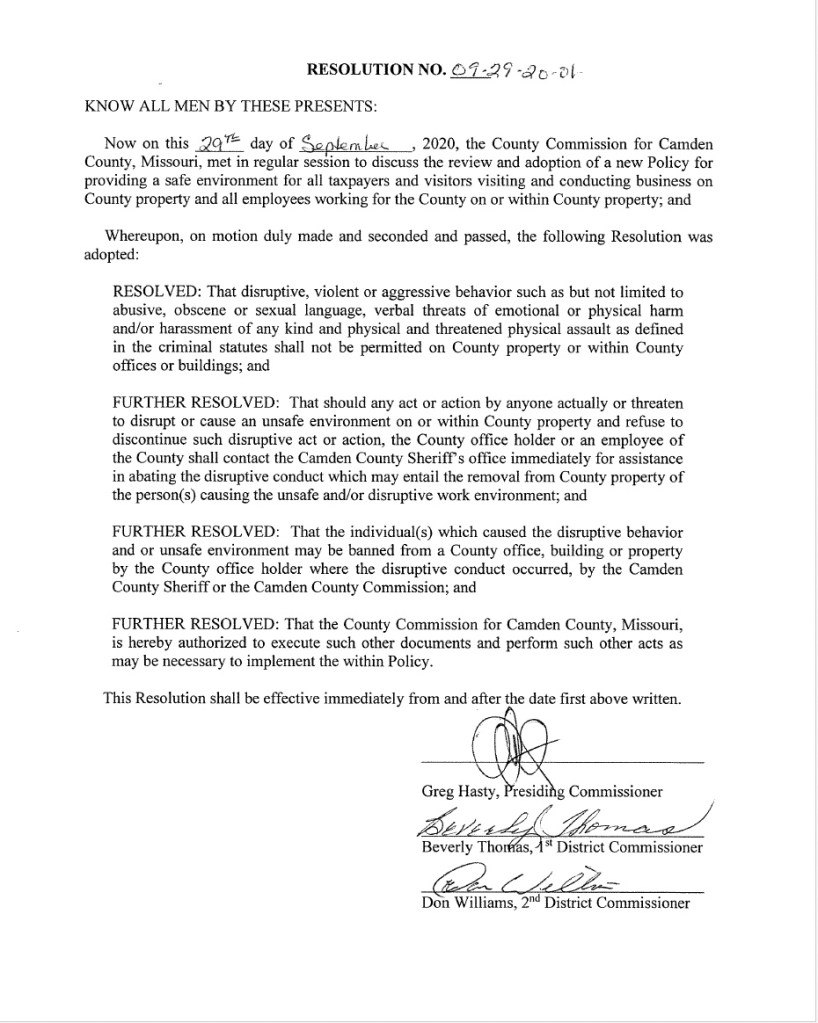
The third agenda item was “Discuss Possible Revocation of Resolution 09-29-20-01 – Allowing Banning Individuals from County Property.”
Nathan Rinne spoke to the Commission about the county’s resolution that allows them to ban citizens from county property.
(For anyone who doesn’t know who Nathan Rinne, I’ll provide an excerpt from my October 14, 2021 Commission meeting article. To avoid any confusion, the Camden County Prosecuting Attorney referred to in this is Caleb Cunningham, the previous prosecutor:
“Commissioners Hasty and Williams voted to ban Rinne from all Camden County property back in approximately March of 2021. The ban letter informed him that if he set foot on Camden County property, he would be escorted off the premises by deputies. Rinne then went to the Camden County courthouse to vote and posted a video of himself leaving the courthouse to Facebook.
A detective from the Camden County Prosecuting Attorney’s Office then wrote a criminal search warrant for Rinne’s Facebook account and seized all of Rinne’s Facebook content pursuant to that warrant. Apparently, no Camden County Sheriff’s deputies would write the warrant and no Camden County judges would sign it, so the detective took it to a Laclede County judge to get it signed.
Nathan Rinne then filed a federal lawsuit alleging that his civil rights had been violated by the ban.“
Rinne vs Camden County is still moving through the federal court system and heading to trial. The federal judge has issued a preliminary injunction against the county and denied former commissioner Greg Hasty qualified immunity. Also, can you believe I’ve been writing about these meetings for over 4 years? Sheesh.)
Rinne stated the following:
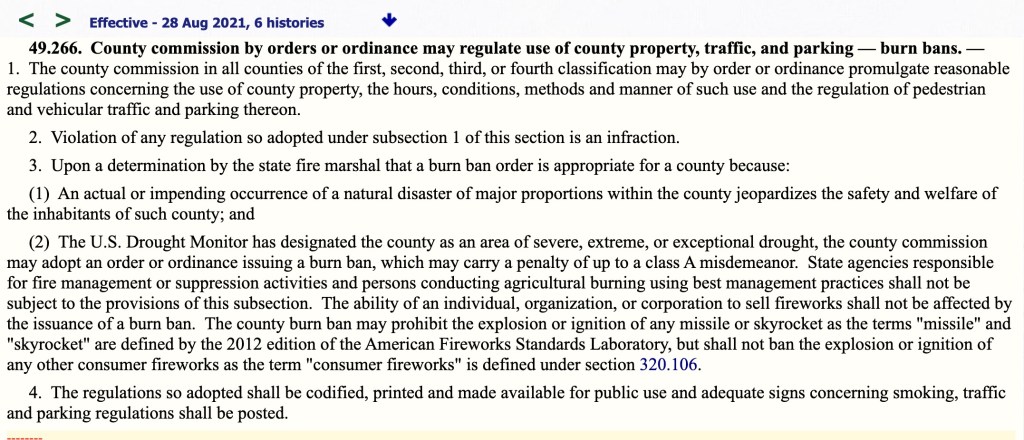
According to Missouri Statute 49.266, county commissions by order or ordinance may regulate the use of county property, traffic and parking. Rinne pointed out that since the existing ban document was a resolution, it was neither an order nor an ordinance.
Rinne explained that in Missouri, there are two types of counties: Home Rule counties and Dillon Rule counties. (Missouri counties with a population under 85,000 have to be Dillon Rule counties.)
Under Dillon Rule, when there is a state law in place, you have to follow it to the letter of the law. Rinne commented that the Commission had enough trouble getting the Prosecuting Attorney to enforce an ordinance (likely referring to the license plate reader ordinance) and doubted she would be willing to enforce a resolution for them.
Rinne stated that a resolution was “literally an opinion.”
Rinne’s second point was that the statute also stated that violation of any regulation so adopted would be an infraction. Not a trespass. It would be a non-criminal offense.

Finally, the adopted regulation should be codified, printed, and made available for the public. Rinne observed that the county’s resolution was not available anywhere for the public to view.

The resolution allowed any county official to ban a person for any act, action, or threat to disrupt. Rinne questioned how someone would “threaten to disrupt” and what their definition of disruption might be.
Using common sense, county officials could ask a person to leave, but couldn’t tell them they could not return. Rinne said that Sheriff Edgar told him that his deputies would only enforce any similar resolution/order if the individual was threatening or violent.
The resolution itself described no due process. There was no option to have a hearing, talk to witnesses, or any procedure other than simply banning the person. Rinne observed that the person who wrote this resolution appeared to have only the most minimal understanding of the law if only because they tried to make a law with a resolution. Rinne cautioned the Commission that the use of this resolution was a legal risk for county officials, especially considering that the main target of the resolution would be individuals who were exercising their 1st Amendment rights. He felt that the Commission should revoke the resolution.
Presiding Commissioner Skelton was not a fan of the resolution and felt that banning someone should only be considered as a last resort.
Commissioner Gohagan stated that government won’t ever get better if it can’t take criticism or feedback from the public. He noted that there had been no due process for either of the people who had been banned by the previous Commission.
Commissioner Dougan agreed with this.
The Commission voted unanimously to revoke this resolution.
The fourth agenda item was “Remainder of Road and Bridge Spring Bid Awards.”
For hot mix asphalt overlay, they accepted the bid from Capital Materials
For snowplow blades, they accepted the bid from Foley Equipment.
For tires, they voted to send out new requests for bids.
For roadway signs, cones, and barricades, they accepted the bid from Vulcan Aluminum.
For fuel, they accepted the bid from Frisco Fuel and the variable market pricing.
For batteries, they accepted both bids from O’Reilly Auto Parts and Battery Outfitters.
The final agenda item was “Discuss Road and Bridge Personnel.”
Tom Abbett from Ozark Amphitheater was present at the meeting and Presiding Commissioner Skelton invited him to address the Commission. Abbett discussed the need to widen North Business Route 5 to allow for the striping of a center turn lane that would permit event traffic to have an extra lane to enter and exit the amphitheater before and after events. The proposed widened road would stretch from Pier Thirty One Court to just past Old Route 5. This would relieve a lot of the traffic issues and enable traffic to enter and exit the venue more efficiently.
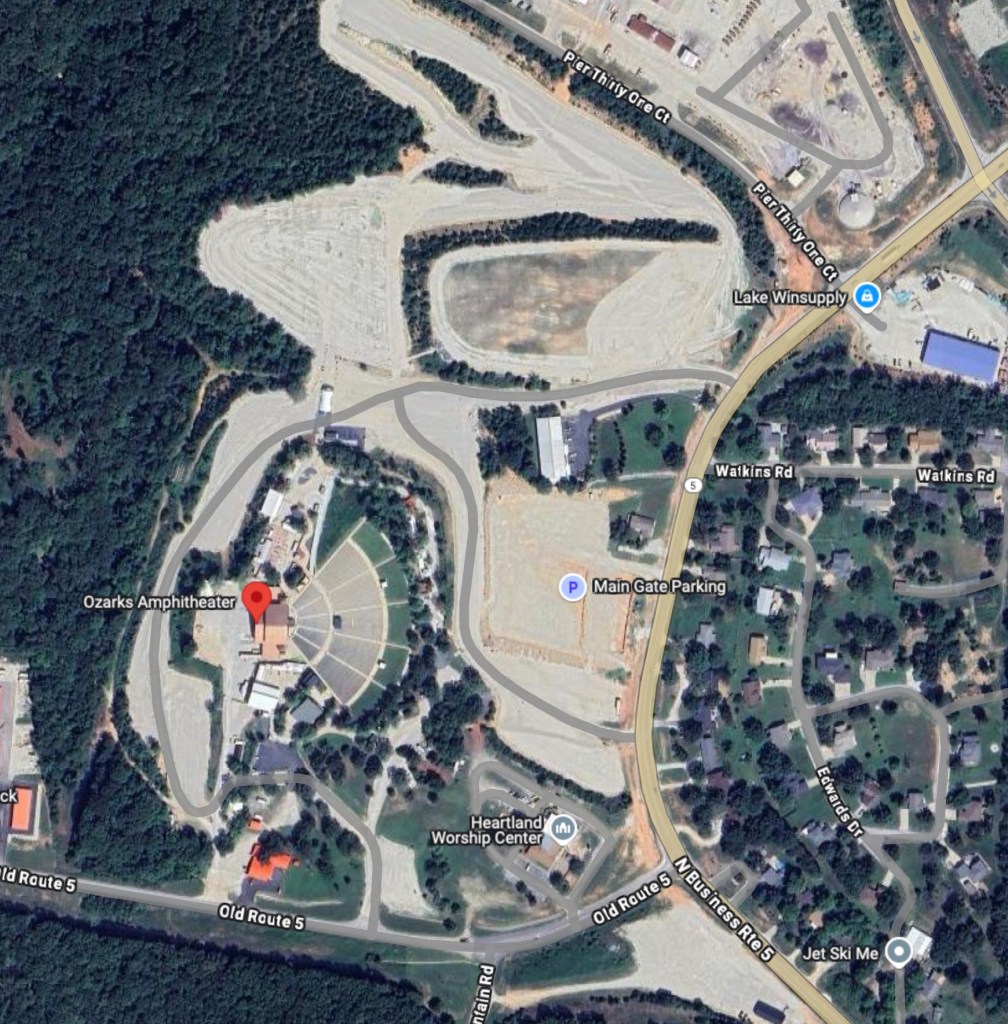
Pat Wolf, the Camden County Road and Bridge Administrator, estimated that widening the road would cost approximately $75,000 to $100,000. There is more than enough right of way, but they would have to modify driveway aprons and move some road culverts. Abbett agreed that he would be willing to pay for the asphalt cost if the county would take care of the dirt work.
Once they settled on a tentative plan, the discussion shifted to the current situation at Camden County Road and Bridge.
Pat Wolf (the R&B Administrator) confirmed that they have $748,000 in impact fees left over after the cost of the Willow Creek Bridge contract. The department has saved an extra $640,000 this year by using new road surfacing techniques. Their current starting pay is $19/hr which makes them competitive with MODOT’s starting pay of $19.67/hr. Wolf explained that Camden County offers slightly better benefits than MODOT. They have quite a few applicants interested in positions and they’re happy with the quality of the people who are applying.
They’re considering starting a 5 employee ditch crew to focus on ditch repair throughout the county. Wolf was hoping the department might be able to add 3 full time employees and 2 seasonal employees.
Presiding Commissioner Skelton noted that the county used to do asphalt maintenance on 11 road miles per year and this year they’ve improved to 55 annual miles. He felt that the reorganization of the department (creating a road boss and freeing Wolf up to pursue more administrative and planning responsibilities) had made a big difference in the department’s operations.
Commissioner Dougan stressed that he wants to make sure that any increases in pay or employment positions were sustainable year after year. He felt that the more established employees should have pay and assigned positions that corresponded with their experience.
Wolf calculated that a $1/hour across the board pay increase, hiring 3 new full time employees, and 4 seasonal employees would cost the Road and Bridge Department $387,000 more per year.
Wolf and Skelton agreed that those seasonal employee positions would also be a good way to vet future full time employees.
Commissioner Gohagan asked Auditor Laughlin if the county had enough revenue to pass another COLA increase this year? Jimmy was hesitant to commit to anything so early into the fiscal year, but he did say that Camden County has had a COLA increase every year since 2019.
The Commission wrapped up this agenda item by voting unanimously to transfer $387,300 to the Road and Bridge Wages and Benefits budget line to create 3 new full time positions, 4 seasonal positions, and allow for a $1 across the board raise for the Camden County Road and Bridge Department.
And that was that.
This was the first time I really got a good look at Camden County’s ban resolution and while I am not an attorney, even I can see that it doesn’t look good for the county. If RSMo 49.266 is the statute that allows the county to restrict access to its property, it is pretty explicit that any violation of it other than burning things would merely be an infraction. This then raises the question of how the former Camden County Prosecuting Attorney’s Office was able to write a search warrant that alleged Rinne had committed the crime of Trespass? None of this ever passed the smell test, but it does appear that it was explicitly illegal.
Rinne has prevailed so far at every turn in his lawsuit against Camden County and its two former commissioners, but this revelation might prove to be the coup de grace to the county’s defense.
 Among the Dogwoods
Every county should have at least one Nathan!!
LikeLike