My dad and I drove out from Mexico, MO, to the small town of Centralia, MO, to explore a historical site that you don’t really hear about very often. Centralia is a small town just west of Mexico that has slowly evolved from a farming/railroad town into a bedroom community for Columbia. On September 27, 1864, this town would become the location of one of the most lopsided battles in the history of the Civil War.

General Sterling Price was in the process of invading Missouri from Arkansas and the Confederate guerrilla bands had been instructed to create as much havoc as possible to tie down Union troops who might otherwise be deployed to oppose Price. On that fateful morning, William “Bloody Bill” Anderson and a band of mounted Missouri guerrillas (or “Bushwhackers”) rode into town, looting, robbing, and generally drinking any booze they could get their hands on. They even came within a hair of capturing a US Congressman who was riding in a coach on his way to Mexico, MO.
As they were terrorizing the locals and settling old scores, a train pulled into Centralia. The guerrillas stopped the train, relieved the passengers of their valuables, and killed 22 uniformed but unarmed Union soldiers who had recently been discharged from active duty.
Once this bit of cold-blooded business had been completed, Anderson and his men sent the burning train down the tracks and rode out of town to the southeast. Shortly after their departure, Union Major Andrew Vern Emen Johnston arrived with approximately 160 raw Union troops mounted on mules and farm horses. There can be no doubt that Johnston was shocked by the bloody scene and he was dead set on pursuing and punishing Anderson’s force. The townspeople tried to warn Johnston that Anderson’s band was large and well-armed, but it’s quite possible that Johnston was suspicious that they were just trying to give the guerrillas a chance to get away. Regardless, he set out after the marauders, leaving a small, very, very lucky garrison to secure the town.

Well, unfortunately for Johnston, he did find them.
As is common with most irregular warfare, there are many variations of the exact details regarding how the fight transpired. One version describes that a small handful of mounted guerrillas lured the Union forces into a trap, always riding away as the pursuers got too close. What we do know is that Johnston rode approximately two miles southeast of Centralia where he came to a slight rise in the prairie. He dismounted his men and left some of them behind to hold the horses. The 125 remaining men of the 39th Missouri formed a battle line and marched over the crest of the rise and down into the meadow. They were armed only with muzzle-loading rifled muskets and bayonets.
In the middle of the meadow, the Union soldiers probably would have seen the 80 or so men of Anderson’s band camped in the meadow. What they couldn’t see was the force that was waiting in the woods that formed a giant horseshoe shape around the meadow. These were the other 320 armed guerrillas that Anderson had gathered for his campaign to assist General Price. As Johnston’s men slowly marched down into the closed end of the horseshoe, they must have wondered why Anderson’s outnumbered men didn’t seem very worried.
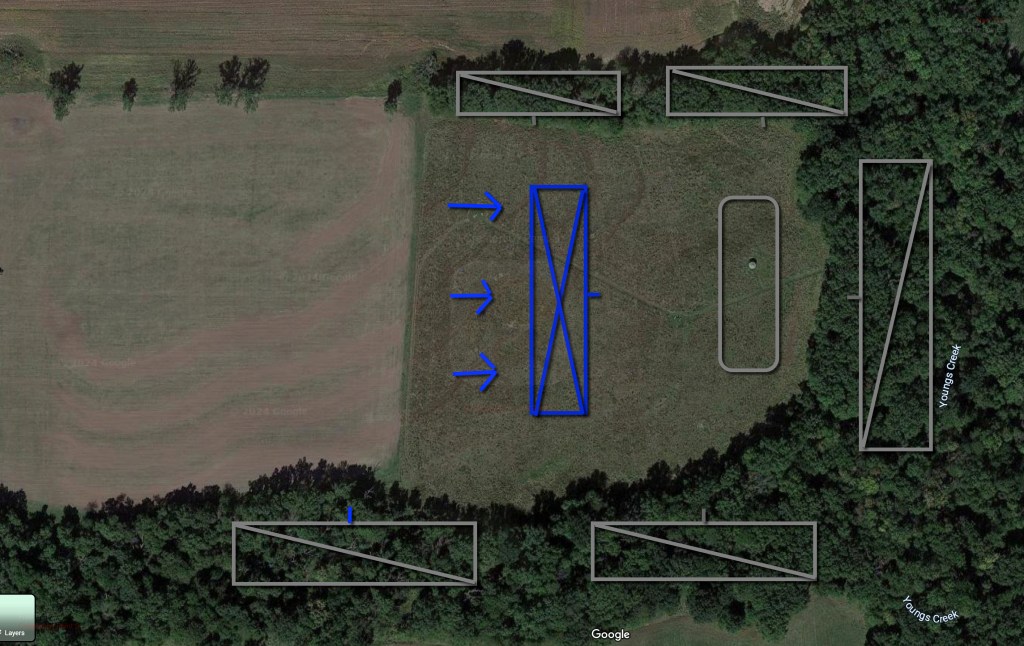
Suddenly, Anderson’s men mounted their horses. As they charged toward the blue line of inexperienced troops, other bands of mounted horsemen burst from the woodlines in front of and behind the flanks of the Union regiment Johnston’s force managed to fire a single volley, but it was ineffective. They most likely fired too high. This was a common problem with raw troops that would have been made worse by the fact that they were slightly uphill from Anderson’s cavalry.
Within seconds the guerrillas overran the 39th Missouri, revolvers blazing. With no time to reload, the Union troops broke and fled, but they couldn’t outrun their mounted opponents. The guerrillas expected no quarter from the Union, and they offered them no quarter. 123 Union soldiers were killed in the battle while Anderson’s force lost less than a handful. The majority of the Union troops who did survive were most likely from the detail that was left behind to hold the horses.
It is notable that there were almost no wounded Union soldiers so it’s a safe assumption that any of the wounded Union troops were executed by the guerrillas. At this stage in the irregular war in Missouri, this was not that unusual. Most guerrillas could expect to be killed, scalped, or worse if they were taken alive and neither side was interested in taking captives unless they had some personal connection from before the war. It was simply a brutal time.
In fact, Bloody Bill Anderson was in an even bloodier mood than usual on this day because he claimed that six of his men had recently been scalped by Union forces. Witnesses reported Anderson told the discharged Union soldiers on the train, “You Federals have just killed six of my soldiers, scalped them, and left them on the prairie…I will show you that I can kill men with as much skill and rapidity as anybody. From this time forward I ask no quarters and give none. Every Federal soldier on whom I put my fingers shall die like a dog. If I get into your clutches I expect death. You are all to be killed and sent to hell” (p. 140, Black Flag, Goodrich).
Anderson himself would be killed in combat within a month. And because this was a guerrilla war, once the Union forces discovered what had happened at Centralia, they took revenge on the easiest targets at hand, the civilian population who lived in and around Centralia. Like I said. Brutal times.
Jesse James was also purported to be at this battle and some say that he personally killed Johnston, the Union commander. I found this interesting because, like 94% of all Missourians, I claim to be related to Jesse James.
So how does the battlefield look now? It’s a short 5 minute drive from Centralia itself and the route is clearly marked with signs. I hope you appreciate the photos because my dad always rolls his eyes when I’m taking shots of everything.
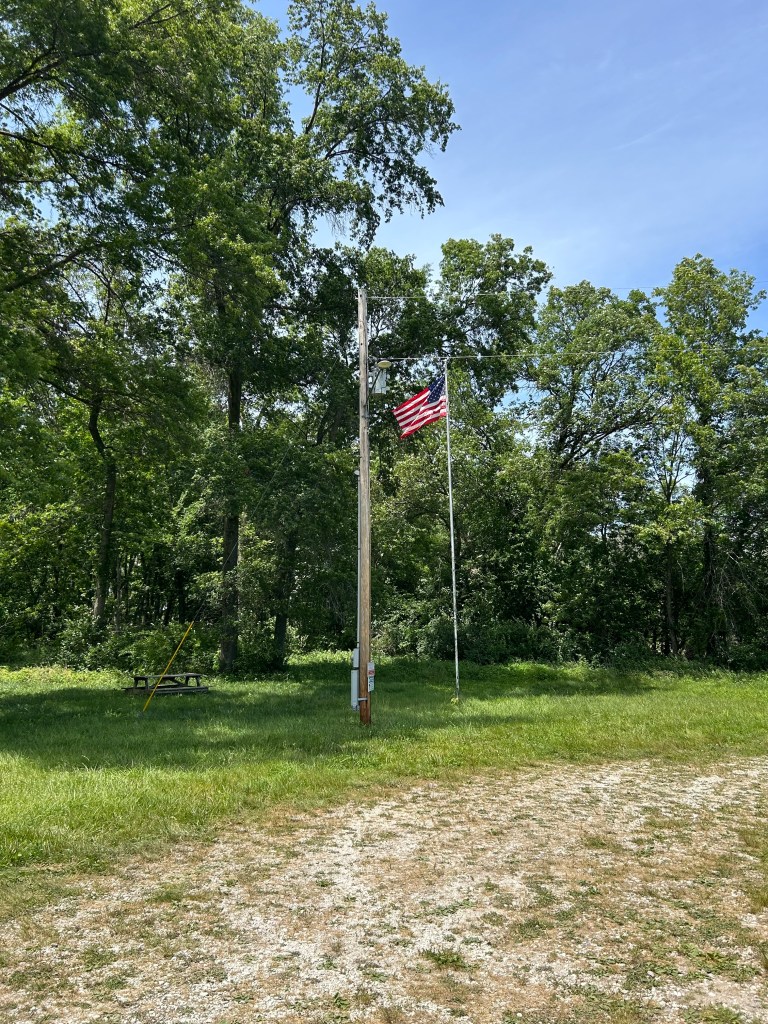
There is a dirt parking lot and some picnic tables. It is a little overgrown and, brace yourself, my dad and I were the only people there. I mean, it’s not exactly Gettysburg so you have to calibrate your expectations.

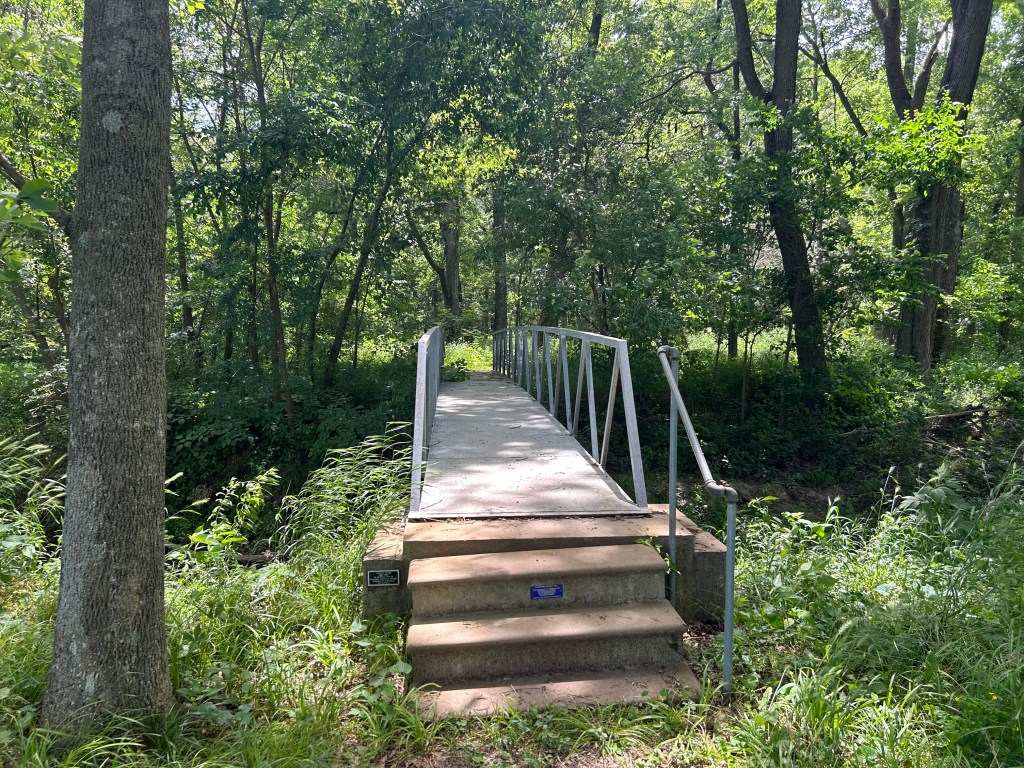
There is a memorial rock and a bridge over the creek that ran through the woods. These were the same woods where most of the guerrillas were hiding and the battlefield looks remarkably similar to contemporary descriptions of it. The bridge was obviously put in after the battle for those visitors who prefer not to ford creeks.
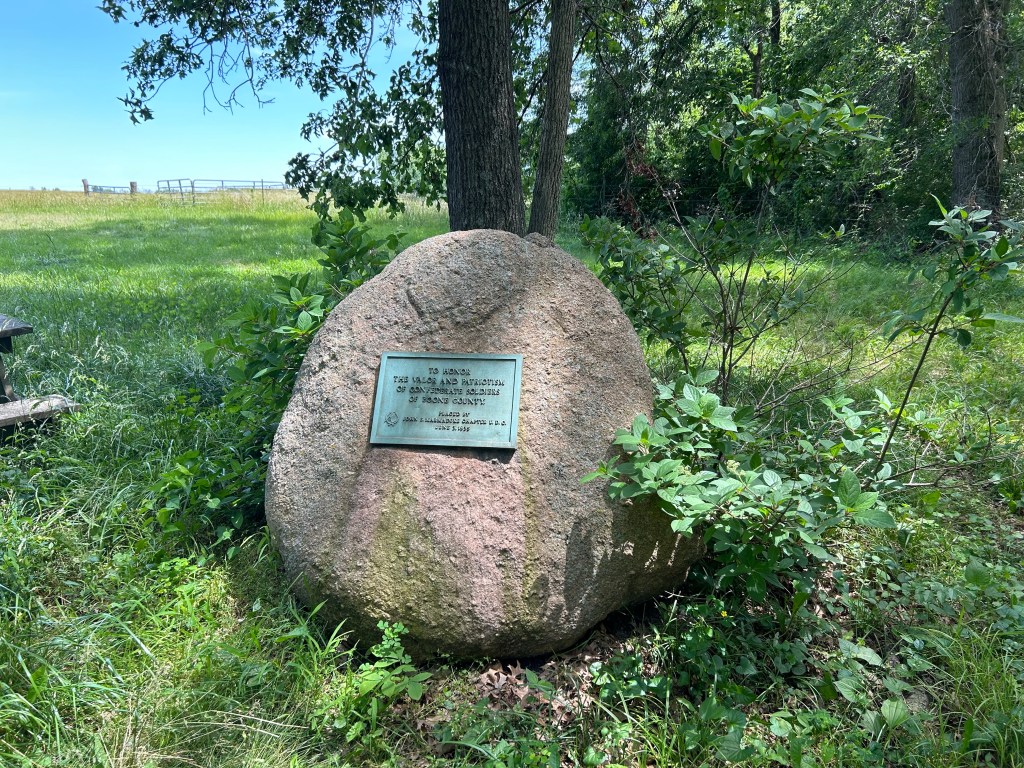
Once you walk through a path that was fortunately mowed by someone who cares about this battlefield and ticks, you walk out into the meadow. There is a gazebo out in the meadow (Again, I have no idea why) and a memorial marker for the Confederacy and a memorial marker for the Union.
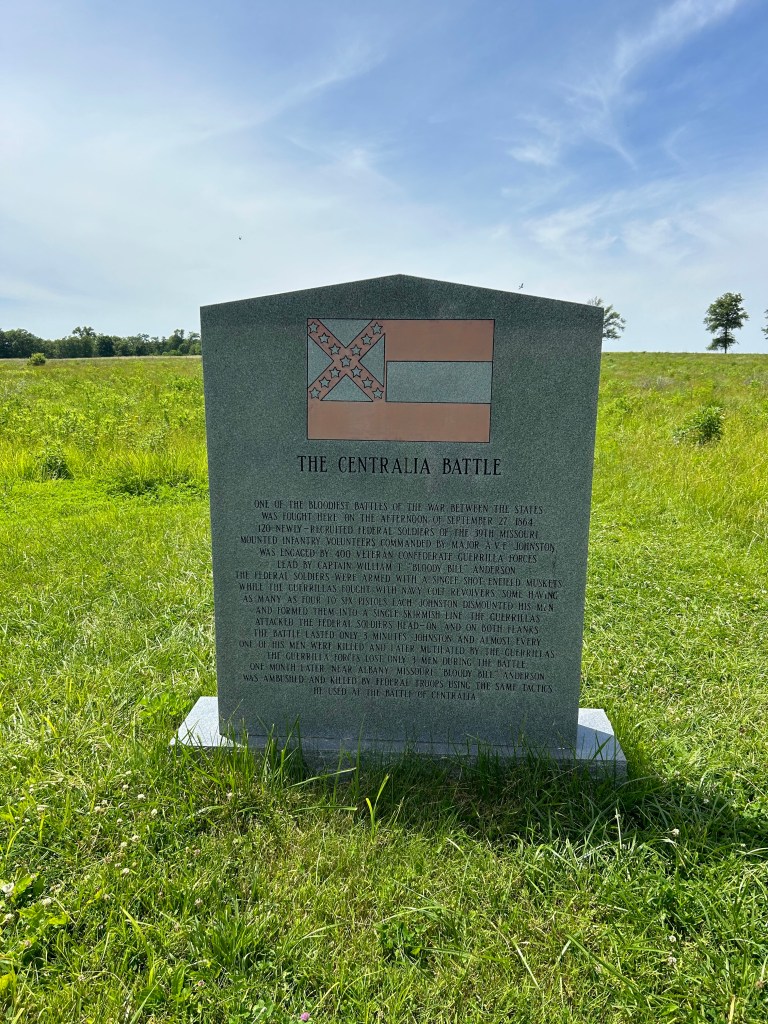


And below is a view from the meadow where Anderson’s men were camped and visible to the Union. You can see how the ground slowly rises to the crest where the Union left their mounts.
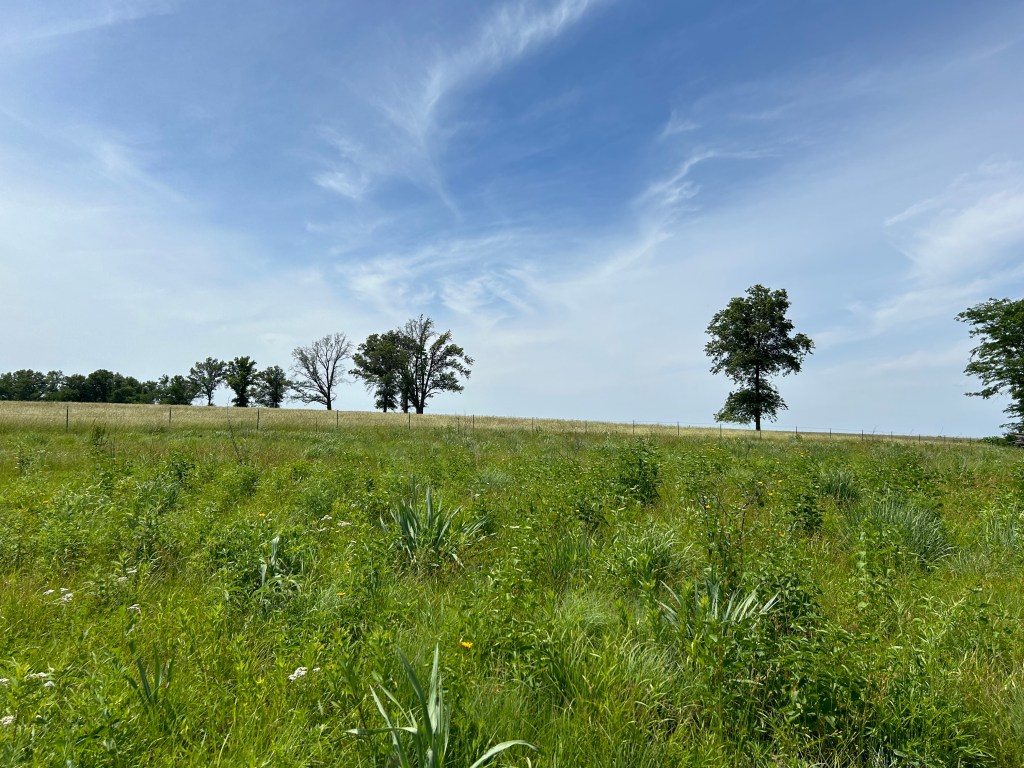
And here is a view from Johnston’s Union troops as they marched down into the meadow. The woods probably extended even further to either flank back then. Hmm, what could be lurking in those woods.

After walking the battlefield, we got some lunch in Centralia and visited the Sturgeon Family Meat Market in Sturgeon. I highly recommend that butcher shop if you’re in the area.


 Among the Dogwoods
This was great.
More!!!
Sent from Proton Mail for iOS
LikeLike
Enjoyed the history lesson! Very interesting.
LikeLike
Thank you so much for that incredible history lesson. Us, our daughter and her 2 boys…6 and 7 were intently listening as I read this. Wow! It was like reading and being there. Thanks again. That was wonder….brutal….but an awesome learning moment.
LikeLiked by 1 person
I’m glad you enjoyed it. There will be more to come.
LikeLike
Looking forward to it. Thanks again
LikeLike
There is a Civil War Roundtable here at the lake that meets monthly. We took a field trip to Centralia a couple of years ago and visited this battle site. They have an excellent museum there as well.
There is also a Civil War battlesight located here in Camden County. If anyone’s interested, you can find out more at: https://militarywarroundtable.org/. All are welcome to attend.
LikeLiked by 1 person
You write so well! I loved reading one of your Camden County notes and it led me to your other posts. I hope you do more!
LikeLike
Thank you. I appreciate the kind words.
LikeLike